Monday, 3 August 2009

Courgette, carrot and halloumi burgers

Tonight's dinner was inspired by a burger Munchkin Granny and Eco Sis had at Borough Market a few weeks ago. It was a halloumi burger, but it was sweet and carroty as well and I had burger envy. I only had a taste so I didn't have too much to go on in recreating it - halloumi and carrot was about as far as I got. I was thinking of adapting our favourite smoked tofu burger, but when I did some searching for possible ideas I found something that sounded very similar on - of all places for a cheesey burger - the weightwatchers website. It also had courgette in it which appealed as we got lots in our veg box this week and it's only me that eats them. Substance was added with tofu and sweetcorn, and flavour with coriander.


When I started making it I wanted to try to avoid using egg as I was making half a batch and didn't want half an egg hanging around. There was no way the mixture was going to adhere on its own - in fact even with the half egg it wasn't looking too promising, and I had to go out to the gym leaving The Scientist to work his kitchen science magic. I got back to a nice smell coming from the oven, and quite a pleased looking boyfriend. He'd just mashed it all up better in the mini processor and that convinced it to hold together. He also used some wheatgerm to give it a coating, and had happily added grated courgette to my half of the mixture.


These burgers were amazing; my new top favourite thing to go in a bun. The halloumi (which is a mix of goat's and sheep's cheese - though some also contain cow's milk) actually wasn't particularly noticeable as a flavour on its own - but the whole was delightfully fresh and tasty. The corn was probably the key flavour, but it was all gratifyingly similar to what I remembered of the Borough market burger - and not laden with bad stuff either. We liked them so much that I made another batch a few days later, so the half egg wasn't wasted after all. The first time we ate them in wholemeal pittas with lettuce and condiments, with some edamame and seaweed salad on the side, and the second time with pittas again, but with stir-fried chard, chickpeas and tomatoes.

Courgette, carrot and halloumi burgers: recipe from www.weightwatchers.co.uk. but the link seems to be broken, so I'll copy it out here. This is for the full quantity

Makes about 8

300g carrots, grated
1 medium courgette, grated
1 medium onion, finely chopped
50g sweetcorn
150g tofu, chopped
75g fresh breadcrumbs
1 medium egg
100g halloumi, chopped
1 Tbsp ground coriander
1 tsp each salt and pepper [I'm sure I didn't use nearly this much I just seasoned the mixture at the end]

Preheat the oven to 200C/Fan 180C/Gas 6. Mist a large baking sheet with oil spray

Put all of the ingredients in a bowl and mix well, seasoning to taste. [I found it easier to put it all in the food processor to get it really well mixed up]

Form into 8 burgers and place on baking tray [we added some wheatgerm as coating]. Bake 20-25 minutes and serve in wholemeal pittas.

Wholewheat pizza night!

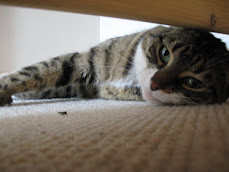
First of all, may I direct your attention to the cats' lovely new photos in the sidebar? I have the Norse Goddess to thank for them - she snapped the cats in lots of languid poses while she was here, and I now feel quite guilty for neglecting to capture their cuteness so much myself. Piggle is snapped stretched out in 'I am a lady-cat of leisure and I invite you to stroke me - while putting myself in an almost impossible to reach place' pose, under the spare bed. And Pooky is looking like a man about town at the top of the stairs, from where he likes to keep an eye on the catflap. This is just in case any other cat than piggle pops in, which would be tough given that our cats have magnets on their collars to ensure that only they can get in. Luckily none of the other neighbourhood cats seems to have the same system - probably because we're the only ones uncouth enough to put a catflap in our front door, and thus ruin the look of the terrace.

Man-handled roast tomato, basil and buffalo mozzarella

Today's post is our fun Sunday-night dinner from last night. We make pizza periodically, but this time I was moved to try a wholewheat base. I was inspired by the fact that The Scientist enjoyed one at Zeffirelli's restaurant in Ambleside. I used my usual dough recipe, torn from an old copy of Good Food Magazine, but substituted half of the white bread flour for wholemeal bread flour. I also added a generous shake of wheat germ, to up its healthy credentials even more. I was pleased with how soft the dough was as I kneaded it, and it made really tasty pizzas. They were certainly more wholefoody than your average pizza, but then home-made is never the same as you buy in the shops anyway (much better, naturally!). We both liked the extra wholesomeyness - and if that's not a word, it should be.

Potato, smoked garlic, goat's cheese and rosemary

I made several small pizzas this time, partly for variety, and partly because we've found that they don't always cook all the way to the centre if you make big ones. Besides, it makes for more fun variety in the toppings. I always make the dough, and The Scientist usually whips up the tomato sauce, while we both manhandle them onto the baking sheets. I had to do that part on my own this time as he was playing in an online poker tournament and was at a critical point when they needed to go into the oven. That explains why one of them is a little 'lacy' around the edges. I was about to make a joke about that being a professional pizza-maker's term when I remembered that actually I did work as a pizza chef in a restaurant in my university holidays. The fact that I had forgotten tells you something about how memorable the pizzas were there. Not so our dinner pizzas: we made one with slow roasted tomatoes and buffalo mozzarella and one with home-grown potatoes (sliced thin and boiled beforehand), rosemary and goat's cheese to share. I did one with shaved courgette and sweetcorn for me, and The Scientist put some cured meat and mozzarella on his.

Courgette, sweetcorn, roasted tomato and mozzarella

And how does all this cheese square with my dairy-reducing aims? Well it's particularly cow's dairy which I'm avoiding, as it has by far the biggest impact on carbon outputs. My main concerns when it comes to diet and ethics are animal welfare and environmental impact. The conventional dairy farming industry has poor conditions for milk cows, which are milked in pens made when dairy cows were much smaller, demands enormous yields per animal, and is very intensive in terms of land use. Organic is obviously better on all of these counts (although ultimately unsustainable for the whole population) and I do eat some organic cow's yogurt. Sheep and goats are farmed a lot less intensively both in terms of welfare conditions and land use, so when I do fancy some cheese, I seek out varieties using their milk - or in this case, buffalo mozzarella. When I first heard about the latter I thought I was falling for some sort of joke, but it really is made from the milk of water buffaloes. There's even a farm in Warwickshire (and you can get their cheese from Hill Top Farm Shop). And I've discovered that Mozzarella style vegan cheezly does a pretty good job of melting on toast and pizza too. But on the whole I just try to find other things to eat than cheese and I don't very often miss it.

Wholemeal Pizza - adapted from an ancient Good Food Magazine
Serves 4 (makes 2 pizzas - I made five smallish ones but I think that feeding four is a bit optimistic - it would probably feed or four mes, but possibly only two normal hungry people)

150g strong wholemeal bread flour
150g strong bread flour
1 tsp instant yeast
1 tsp salt
1 Tbsp olive oil
200 ml warm water

Put the flour into a large bowl, then stir in the yeast and salt. Make a well, pour in the warm water and the olive oil and bring together with a wooden spoon until you have a soft, fairly wet dough. Turn onto a lightly floured surface and knead for 5 minutes until smooth. Cover with a tea towel and set aside. You can leave the dough to rise if you like, but it's not essential for a thin crust [I don't bother usually as it makes for such a quick and easy supper]

Preheat the oven to 240C/Fan 220C/Gas 8, and move the shelves up to high. Put two baking trays into the oven to heat up (or use a pizza stone which I am always tempted by but haven't given in to buying yet).

Roll out the dough. If you've let the dough rise, give it a quick knead, then split into two balls. On a floured surface, roll out the dough into rounds or squares, using a rolling pin. The dough needs to be very thin as it will rise in the oven.

Top as you prefer. Our quickest and easiest tomato is topping is just some watered tomato paste with some seasonings, but otherwise we make up a nice herbed sauce using tinned tomatoes and fresh herbs if we have them.

Remove the baking sheets from the oven and scatter with cornmeal. Slide, peel or tear the pizza dough off whatever you've left it on and onto the baking sheets. Bake 8-10 minutes, alternating the oven positions half way.

Tuesday, 28 July 2009

Vanilla poached quince and apricot

Gosh darn it, I was just about to go out to the gym and it's started raining - and The Scientist has just left to play cricket (of course). So I'll write a blog post and hope it stops. The weather we're having at the moment it might last 4 seconds or it might last all evening.


Anyway, this is a dessert I made a couple of weeks ago after finally spying some quince in a local greengrocer. I've been intrigued by quince since reading Nigella Lawson's How to be a Domestic Goddess, where she features it in several recipes. It's a quintessentially English orchard type of fruit and yet I have never previously seen it in the shops, despite looking. I snapped up two and gleefully brought them home with no particular idea as to what to do with them. They are hard, yellow fruits that look a lot like apples (and are related to them) but I don't believe that you would want to try biting into a raw one - not if you didn't want to spend the rest of the evening with your lips puckered inside your mouth. They have a long and illustrious history, however, being a symbol of fertility (what isn't?), associated with Aphrodite, and possibly even the fruit that Eve ate in the Garden of Eden. David Lebowitz says that they smell so nice that he likes to leave them in his kitchen overnight just for the fragrance. When I read that I went and sniffed ours, but they didn't seem to have an especially noticeable smell.


A week or so later, kitchen still unfragranced, I decided I should do something with them. I wanted something light, so I settled on a simple poached recipe. David Lebowitz has a couple, one of which particularly appealed because it used a vanilla syrup - one of my favourite flavours. I read all his instructions on how to peel these rather hard and knobbly fruits and set to work prepared for a battle. Alas, I had left my quinces a bit too long, and they were quite soft and dark in places when I cut into them. I had to cut so much off that I was only left with a small pile for poaching. I didn't want to give up, so I remembered the gingery poached dried apricots I made a while ago, and so added some dried apricots to my quince.


I was glad I'd stuck with it, as it made a lovely dessert. The quince was nice and soft, but I particularly liked the contrast between it and the chewier apricots. The syrup was very sweet - you could easily cut back on the sugar if you didn't have too sweet a tooth, or were making it for a breakfast compote, but the vanilla flavour was divine. This will be on the list for the next time I stumble upon a quince - whenever that is. Funnily enough though, I also found another ingredient I've been searching for for years this week - samphire. My PhD supervisor's wife used to cook it for their summer parties, but I have never found it anywhere. I finally found it at Borough Market last weekend and brought some back. I just steamed it lightly and ate it atop a poached egg on an English muffin. It was salty and yummy. I wish I'd bought more.

Vanilla poached quince recipe here (and I can recommend adding a few dried apricots too)

Sunday, 26 July 2009

Sometimes you just need a chocolate muffin

Long week. Hard work. Guests for dinner. Needed chocolate-based dessert


That much was clear on Friday night, and the need was enough to make me cut to the chase. For once I didn't look through a million recipes and change my mind six times. Instead I searched for 'chocolate' in my geek-tastic document entitled 'Baking', where I paste all the delicious looking recipes I find on blogs and websites, and stopped when I got to Dan Lepard's Chocolate custard muffins. I don't mind admitting that it was the word 'custard' that got me in particular. Such a comforting word - the stuff of childhood and blissful ignorance of the world of deadlines and grant proposals (don't get me started). No matter that I don't remember eating custard even once as a child (angel delight was our dessert of choice); it has still entered my cultural memory and occupies a hallowed place there.


The recipe was unlike any other muffin I've made. I had imagined that it would be a chocolate cake with custard in the middle, but in fact the whole batter is a custard - starting with a cornflour/water/cocoa/sugar combo in a saucepan, and adding butter, flour, oil, eggs, etc, once it's melted and thick. I used arrowroot powder instead of cornflour, because I hadn't been able to find cornflour last time I was in the supermarket, and it was fine. Cornflour is, of course, NOT cornmeal, but a thickener. I did all the stirring and melting as I prepared dinner, and had the mixture waiting in its pan so that I could add the final ingredients, put it in the cupcake liners and in the oven as The Scientist came back from picking up our weekend guests (Eco Sis and Eco Bro, here to attend the Warwick Folk Festival with us and Munchkin Gramps et al). Dinner was a somewhat eclectic - one could even say random - stir fry with tofu on rice noodles, with shop-bought spring rolls - and potato croquettes, which had apparently leaped into The Scientist's basket with no sense of decorum or grace. They are part of his set of childhood foodie memories; to me they represent Rag Week at croquette-eating competitions at college, which does still show how popular they are amongst children and students alike. Luckily the Ecos are very open to the mix-and-match approach to cookery. We initially deferred the dessert but then got seduced by the baking smell, and tried them straight away. They were very chocolatey, so the main aim was achieved, and while we got distracted by artfully arranging them for their photo and so didn't discuss their custardyness, we did agree that they were nice and moist. I would definitely make them again, and would perhaps save some of the chocolate chips to stir in at the end so that they stayed whole. In fact I had meant to stir in some raspberries, but forgot (naturally). They could probably take all sorts of additions - banana would be very nice, I should think.

Eco Bro's elegant styling in rather poor light - I won't even mention how my efforts came out!

PS to Grandma S or Junior S if you're reading this: sorry I forgot to offer you any the next morning when you came round! I will make them again next time :)


Chocolate custard muffins, from Dan Lepard's Guardian column

50g cornflour [or arrowroot powder]
3 level Tbsp cocoa powder
100g dark soft brown sugar
225ml cold water
75g unsalted butter, broken small [I used vegan margarine]
75ml sunflower oil
2 tsp vanilla extract
2 large eggs
125g caster sugar
125g plain flour
2 1/2 tsp baking powder

First make the custard: put the cornflour, brown sugar and water into a saucepan and whisk together over a medium heat until boiling, very thick and smooth [this takes several minutes but you'll know when it happens - it suddenly goes *very* thick]. Remove from the heat, beat in the butter and chocolate until melted and absorbed, then add the oil, vanilla and one of the eggs and beat again until combined. Add the remaining egg and caster sugar, and beat again until smooth and thick.

Measure the flour and baking powder into a bowl, stir together, then sift directly on to the custard and beat through until combined. Spoon into a dozen paper muffin cases sitting in the pockets of a muffin tray [I got 14], and bake in a preheated oven to 180C [that's 250F if you're making these, Norse Goddess!]/Gas 4, and bake for 25 minutes. Briefly try to resist chocolatey baking smell, and then eat, happily.

Thursday, 23 July 2009

Joyous tomato and cabbage pilaf

This simple dinner was inspired by a bag of cherry tomatoes I bought at Borough Market when we were in London last weekend. That and the fact that the tomato-hating Scientist was out playing cricket (or trying to - that boy is very unlucky with the micro climate around here. He came back having got soaked; it had showered for two minutes here, only 15 minutes' drive away).


I had initially planned to make a simple tomato sauce for a pasta dish, but as the day wore on I began to fancy something featuring the crunch of my favourite grain, bulgar wheat. In the end I decided to keep with the simple and made this lovely pilaf, throwing in some cabbage we had in the fridge as well. My favourite way of eating tomatoes (apart from straight from the bag, like sweeties) is to roast them with some balsamic vinegar. It concentrates all the flavour and gives them a nice chewy texture as well. I put them in the oven and then got on with the rest of the cooking after about 20 minutes. This extra stage really made the dish, but you could just cook them in the pan when the bulgar goes in if you prefer not to turn on the oven. My dinner merited a happy dinner wiggle as I ate it, with some plain yogurt on the top, and a bit of wholemeal pitta bread on the side.


Tomato and cabbage pilaf
The trouble with making up my own dishes is that I pay no attention at all to quantities, so this is a rough guide rather than a proper recipe. I was just cooking for one, though as usual I made too much.

Cut a handful of cherry tomatoes in half (I did loads so as to have lots left over for other dishes and general snacking). Put them in a roasting tin and drizzle over some balsamic vinegar, some shaosing wine, a grinding of salt and pepper, and some fresh basil (or whatever other herbs you prefer). You can also add oil but I let the other liquids do their thing in preference. Roast in a preheated oven at around 180C for about half an hour - but leaving them longer just makes them even nicer and more chewy.

After about 20 minutes of roasting, fry some onion in a pan with a little oil. When it softens add some garlic (I used half of a big clove and it was very garlicky!). After a few more minutes add some shredded cabbage and cook for another few minutes, stirring often. Add about 50g bulgar wheat, stir and then add stock, to cover. Put a lid on the pan, and leave to simmer gently for about 10-15 minutes, until the bulgar is cooked. Serve with the tomatoes on top, and some plain yogurt to hand for drizzling. Dinner wiggle is optional, but advised.

Sunday, 19 July 2009

Beetroot and rhubarb soup


I love home grown produce, but I have to admit that my own record in this regard is a bit patchy. So far this year I have failed at least as much as I've succeeded, although I have been very proud of my potatoes (grown in sacks), blueberries and rocket. My little apple and pear trees are looking a bit mournful just now, though I have just moved them into bigger pots to try and appease them, my tomatoes are ok-ish, and the strawberry plants bore fruit very briefly. The butternut squash plants which I planted from seed, and which shot to adolescence under Vicki's careful tending and sun lounge when we were on holiday got munched to bits the instant I put them in the beds, as did the courgette and the sweetcorn I bought at Kenilworth farmer's market. Evil slugs. I was very unhappy. So I have the utmost respect for anyone who manages a better crop - The Scientist's sister, for example, who has courgettes growing aplenty, and our friends E and D, who have a whole plot of rhubarb, broad beans, courgette and gooseberries. We went to visit E and D a couple of weekends ago to meet their new baby, and D very generously sent me off laden with goodies. The gooseberries became a fool, the broad beans went in a soup, and a lot of the rhubarb was stewed and eaten with yogurt for breakfast. I had a bit of rhubarb left though, and fancied making something savoury with it. I was tempted and inspired by Johanna's rhubarb dipping sauce, and Jacqueline's rhubarb and balsamic dressing. In the end I took elements from both, and partnered my rhubarb with some beetroot in a soup. I did find a recipe for this combination which gave me the clever idea of cooking each in turn in the same water. I liked Jacqueline's balsamic, but modified it to red wine vinegar, which is an ingredient in my favourite borscht recipe. I ended up eating the soup warm as it was a changeable sort of day, but I think it would be very nice cold as well. It was rich from the beetroot, with a slight sharpness from the rhubarb, which I think was enhanced by the vinegar. I was quite pleased as I rarely come up with my own recipes - though I have a number of sources to thank for my inspiration!


Rhubarb and beetroot soup
Served 2

3 small beetroots
2 small sticks of rhubarb
red wine vinegar, to taste.
yogurt, to taste

Cut the tops of the beetroot and place in a small pan of water. Bring to the boil, and cook for about 20 minutes, or until soft. Remove from the water with a slotted spoon, and set aside to cool.

Chop the rhubarb into inch long chunks, discarding the ends, and cook in the same liquid until soft - about five minutes or so. Remove from heat and leave to cool, reserving cooking liquid.

When the beetroot is cool enough to handle, slip off the skins, and chop roughly. Place in a small blender with the rhubarb and enough of the cooking water to make the consistency you like (start with a little and add more). Stir in red wine vinegar to taste, and season. You can stir yogurt through at this stage, or do as I did, and serve it on the top.

Tuesday, 14 July 2009

Belgian buns and Science brownie points


You know how most people have a favourite bakery treat? A custard tart or a doughnut - or perhaps one of those decorated novelty gingerbread men? For me it was always a cheese turnover - a savoury pastry which my best friend and I used to use as fuel on long shopping trips to town to spend our clothes allowances. I don't know how we stayed fuelled on them all day as they were tiny, but we always used to have one each - until the day when we found that Ainsley's bakery in Leeds had a *mushroom turnover* special. Ah, that was a good day.


The Scientist's bakery treat has followed him into adulthood, although I only became aware of it when we moved to Sussex. This is because his favourite is a Belgian bun, and they are not apparently a standard bakery item (a bit like my cheese turnovers I suppose, which I have never seen outside Yorkshire, not that I've had any inclination to look in recent years). A Belgian bun is a bit like a Danish pastry, but with a different type of accent, and made of a sweet bread dough rather than pastry. Other than that it's very similar - a big spiral containing dried fruit and some sort of sweet filling (lemon curd is a favourite) and then coated with icing and a cherry on the top. I'm not certain enough of what the true Belgian bun looks like to risk buying him one from anywhere other than a Forfars Sussex bakery, but he makes sure to pop in and get one whenever we're back on the south coast.

Unbaked Belgian buns

A few months ago we were talking to his sister about childhood treats, and it turned out that she was also a fan of the Belgian bun, although they hadn't been a shared family tradition. A long conversation about the best place to buy them in the town where they grew up ensued, during which I hatched a plan to see if I could recreate this happy childhood memory. I did find a recipe on the internet, on the endearingly named site bun-recipes.co.uk, which looked as though it had the right sort of dough. We don't live very near to Scientist Sister (who is also busy with a young Scientist Nephew Sprog) so I thought I'd take the opportunity of a sup rise retirement party for the Scientist parentals last weekend to try it out.


The dough has the basic constituents of a sweet enriched bread - flour, yeast, sugar, milk and eggs. My recipe directed me not to knead the dough before its first rise, but instead just to leave it in its bowl in a warm place. The dough did rise nicely, and was a bit less sticky by the time it was ready for kneading. Then you roll it out to a rectangle and scatter it with melted butter, sugar and dried fruit, before rolling it back up again. Then slice it into rounds and leave again, before finally baking. I was really pleased with how they looked (though about half the size of the Forfars' model). I drizzled the cooled buns with some icing made from icing sugar and water, and would certainly have gone down the cherry topping route had we had any. Both The Scientist and Science Sister were delighted with their treats and pronounced them just like the originals. I've already had a request to try putting lemon curd in them next time. They were really fun to make, and nice to be bringing back a little of the delights of childhood. I'm sending these Belgian buns to Stefanie at Hefe und mehr (Yeast and more) who is hosting this month's sweet breads-themed Bread Baking Day.

On a slightly related topic: my treacle tart from our Alice in Wonderland party has been thoroughly usurped by this recipe, which Science Sister made at the surprise party last weekend. I'll definitely be trying it myself some time!

Belgian bun recipe here
And if you're after an enriched vegan bread dough you could try Hannah at Bittersweet's pain de mie